
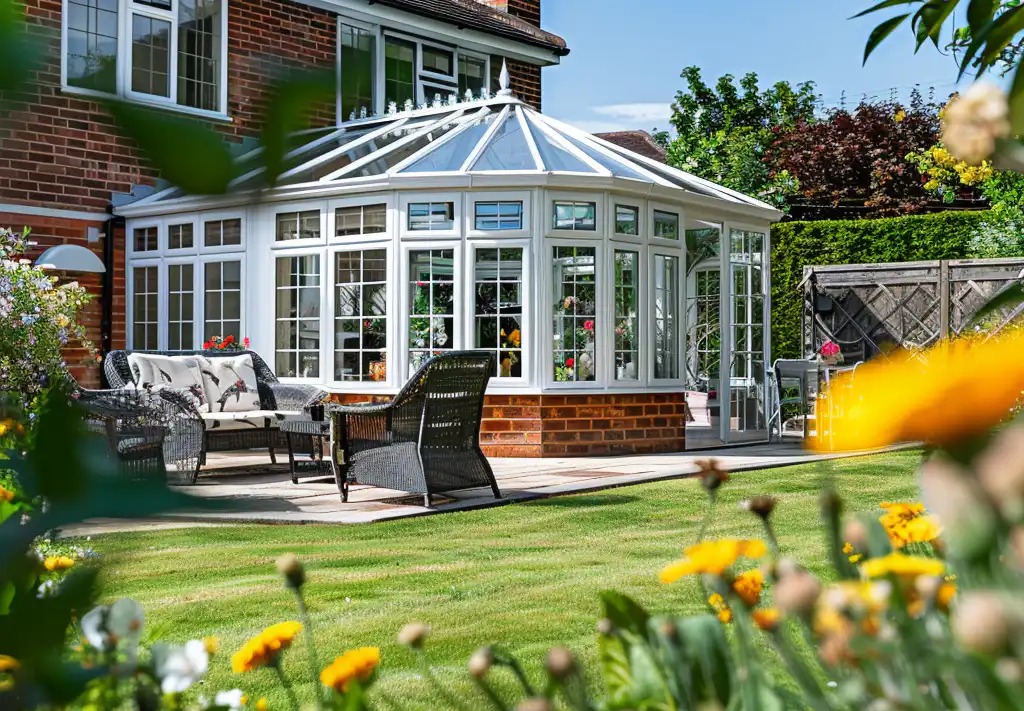
Quick answer: U-value measures how much heat escapes through a material – the lower the number, the better it insulates. For conservatories, a low U-value roof keeps the space warmer in winter, and an opaque insulated roof also blocks summer solar heat. Understanding U-value helps you compare roofing options and make an informed conservatory upgrade decision.
Conservatories often become the coldest room in winter and the hottest in summer. The reason usually comes down to one number: U-value. If you’ve started researching conservatory insulation or ways to improve your EPC rating, you’ve probably seen U-value mentioned alongside technical jargon that’s hard to decode. This guide breaks it down in plain terms, shows you how it’s calculated, and explains why it matters for your comfort, your energy bills, and your home’s overall energy performance.
What is U-value?
U-value, also known as thermal transmittance, tells you how much heat passes through a material or structure. It’s measured in watts per square metre per degree Kelvin (W/m²K).
What U-value measures
U-value measures the rate of heat loss through a building element – a wall, window, or roof – for every degree of temperature difference between inside and outside. In practical terms, it tells you how effective a material is at keeping heat where you want it.
A conservatory roof with a high U-value loses heat quickly. One with a low U-value holds onto warmth far more effectively, which is exactly what you want during colder months.
Why lower U-values are better
Here’s the simple rule: the lower the U-value, the better the insulation. A roof rated at 0.87 W/m²K loses about 64% less heat than one rated at 2.4 W/m²K.
This matters because conservatory roofs are often the single biggest source of heat loss in the space. Choosing a roof with a low U-value can:
- Reduce how much heat escapes during winter
- Lower the amount of energy needed to heat the room
- Improve overall comfort throughout the year
U-value vs R-value: what’s the difference?
You’ll sometimes see R-value mentioned alongside U-value, and it’s easy to confuse the two. They measure related but distinct things.
Why the two are related
R-value measures thermal resistance – how well a material resists heat flow. U-value measures thermal transmittance – how much heat actually gets through. The two are mathematically connected: U-value is the inverse of total R-value (U = 1 ÷ R).
In other words, a higher R-value directly produces a lower U-value. If you’re comparing insulation products, you might see either figure quoted, but they’re telling you the same underlying story from different angles: look for a low U-value or a high R-value.
Why thickness and materials matter
R-value depends heavily on the thickness and type of material used. A thicker layer of insulation, or one made from a material with low thermal conductivity, produces a higher R-value and therefore a lower (better) U-value.
This is why conservatory roof performance varies so much between products. A single pane of glass has very little thermal resistance. Add layers of insulation, air gaps, or specialist panels, and that resistance builds – bringing the overall U-value down.
Why U-value matters in conservatories
Conservatories are particularly exposed to the effects of poor thermal performance because so much of their structure is glazing or lightweight roofing.
Heat loss in winter
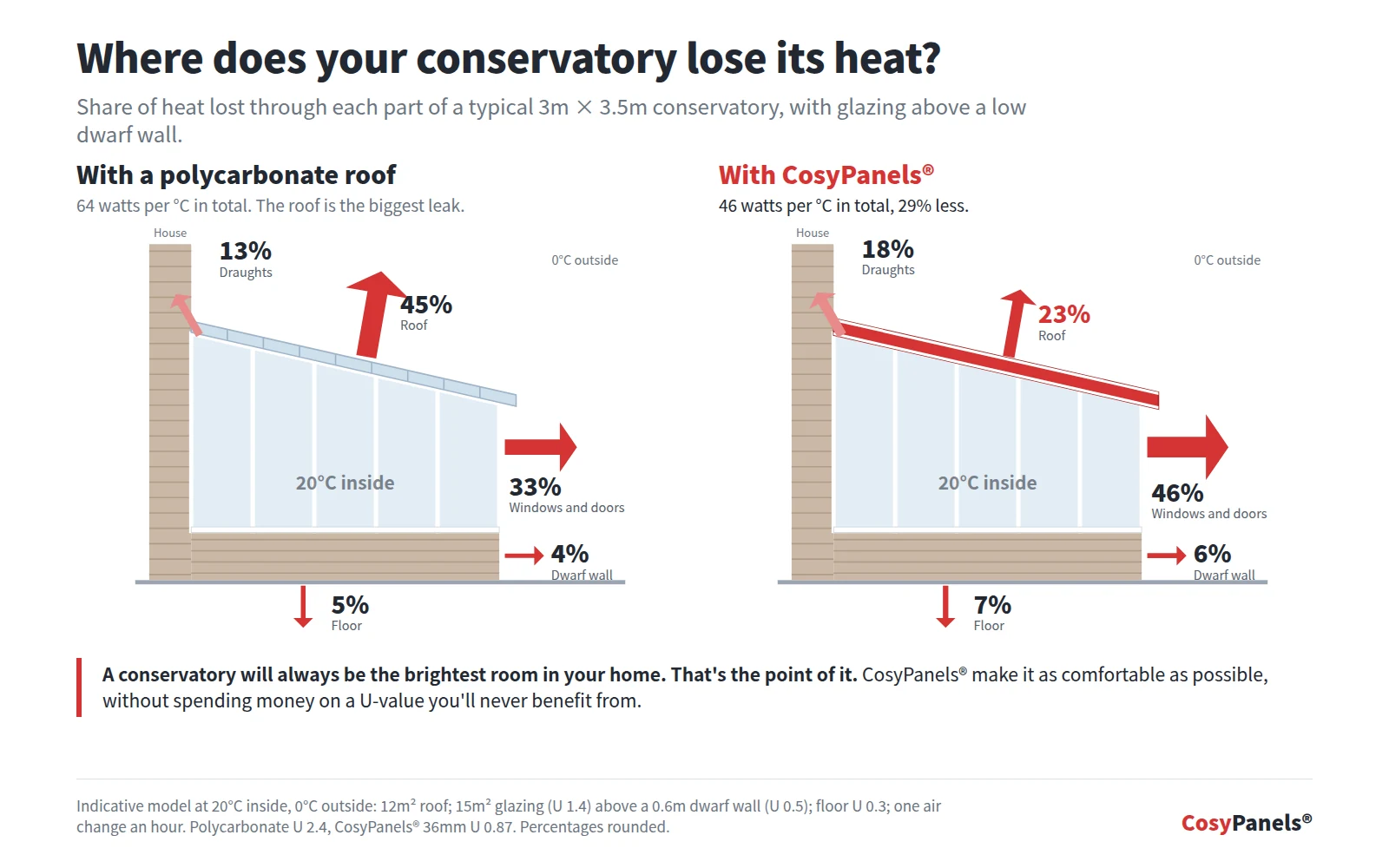
A conservatory roof with a high U-value allows heat to escape rapidly once the heating is switched on. This makes the room feel cold almost as quickly as it warms up, and it pushes up the cost of trying to keep it usable through winter.
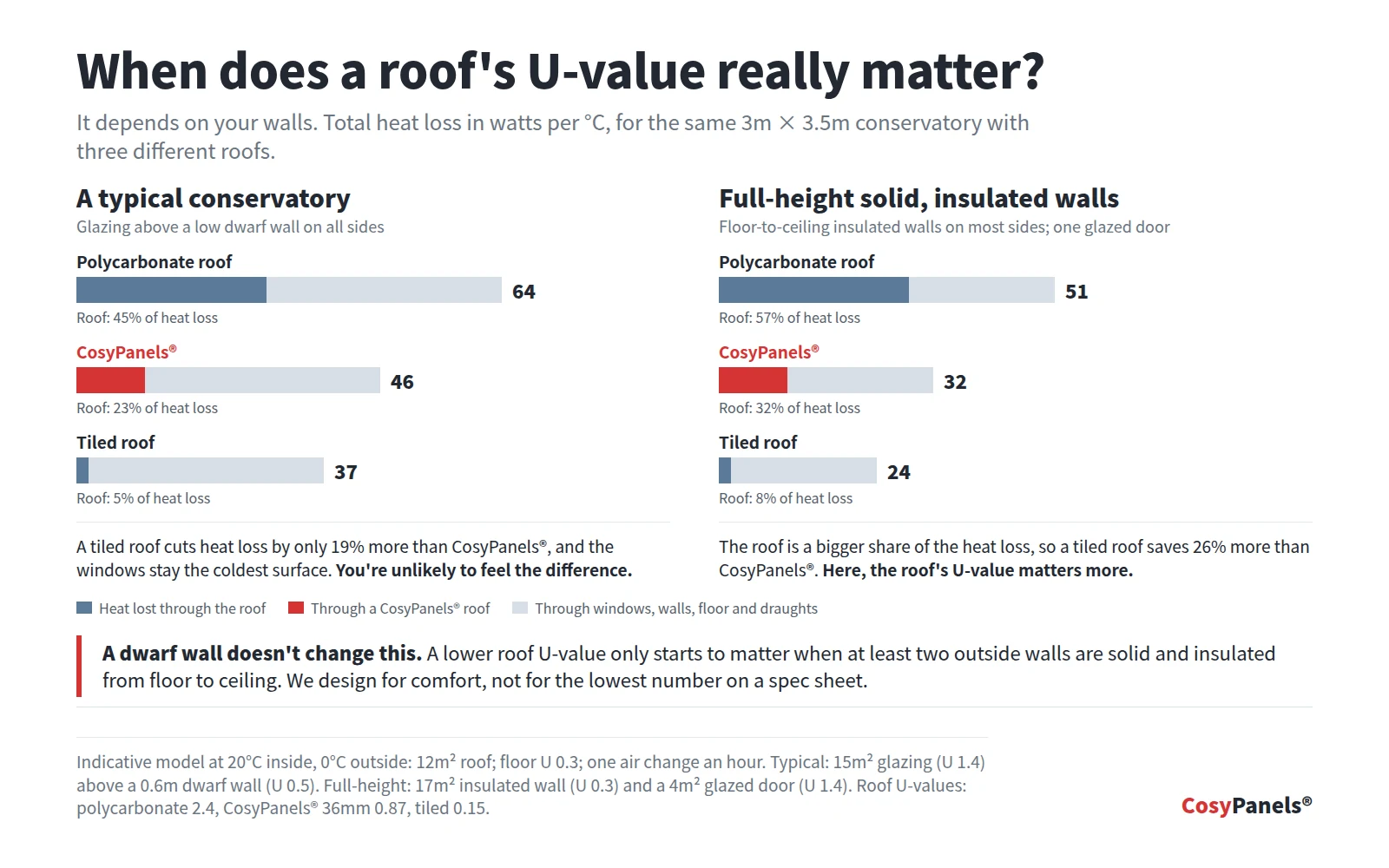
Here’s where a typical conservatory loses its heat, with a polycarbonate roof and with CosyPanels®:
Overheating in summer
The same lack of insulation works against you in reverse during summer. Heat builds up quickly under a poorly insulated, see-through roof, turning the conservatory into an uncomfortable space on sunny days rather than a pleasant one.
Comfort, usability and running costs
Together, these effects explain why so many conservatories sit unused for large parts of the year. According to a government-backed conservatory heating study, around 18% of households in England have a conservatory, and roughly 77% of those are heated. Of the conservatories that are heated, 56% are heated every day during winter – a sign of how much homeowners are already spending to make these spaces usable.
The same research found that median annual gas consumption was higher in homes with gas-heated conservatories (18,200 kWh) compared with homes without one (13,400 kWh), although other factors in the home may also contribute to this difference. A lower U-value roof addresses the root cause: less heat escaping means less energy needed to compensate.
How U-values affect EPC score and home energy performance
Your conservatory’s thermal performance doesn’t exist in isolation – it can influence how your whole home is assessed for energy efficiency.
The link between thermal performance and EPC ratings
An Energy Performance Certificate (EPC) assesses a property’s overall energy efficiency, and the thermal performance of key building elements – including glazing and roofing – feeds into that assessment. A conservatory with poor thermal performance can act as a weak point in the home’s overall insulation, which may be reflected in the EPC outcome depending on how the space is used and connected to the main dwelling.
Why conservatory roofs can make a difference
Because conservatory roofs often have a much higher U-value than the rest of the home’s structure, they can represent one of the more significant areas for improvement. Replacing an older glass or polycarbonate roof with a better-insulated option lowers the U-value of that part of the building, supporting better thermal performance across the property.
How U-value is calculated
U-value calculations can look intimidating, but the underlying principle is straightforward once you break it into its components.
Thermal conductivity and layers
Every material has a thermal conductivity value (known as lambda, or λ), which describes how easily heat passes through it. To calculate the R-value of a layer, you divide its thickness (in metres) by its thermal conductivity. Add up the R-values of every layer in a structure – plus standard allowances for the air films on the inside and outside surfaces – and you get the total R-value. Take the inverse of that total, and you have the U-value.
A worked example: a 36mm insulated roof panel
Here’s how it works for the 36mm CosyPanels® insulated panel we usually install, which has an XPS insulation core with a thermal conductivity of 0.035 W/m·K between 1mm rigid PVC outer layers:
- XPS insulation core: 0.036 m ÷ 0.035 = about 1.03 m²K/W
- Two thin PVC outer layers: about 0.01 m²K/W in total
- Inside and outside surface air films (standard allowances for a roof): about 0.14 m²K/W
Adding these together gives a total thermal resistance of about 1.18 m²K/W.
To find the U-value, divide 1 by the total resistance:
U = 1 ÷ 1.18 = approximately 0.85 W/m²K
That’s very close to the manufacturer’s figure of 0.87 W/m²K for the panel, and it shows why the insulation layer does almost all the work: a thicker core pushes the U-value lower still. For example, a 50mm panel comes in at around 0.64 W/m²K. These are panel figures; the frame and glazing bars of your conservatory also affect the performance of the roof as a whole.
U-values of common conservatory roof materials
Not all conservatory roofs perform the same way. Here’s how common options compare, using indicative figures.
| Roof type | Typical U-value (W/m²K) | Lets in summer solar heat? |
|---|---|---|
| Older single glazing / early double glazing | 2.0–3.0 | Yes |
| Standard double-glazed glass roof | Around 2.8 | Yes |
| Polycarbonate roof | Around 2.4 | Yes |
| Premium double or triple glazing | Around 0.8–1.0 (product-dependent) | Yes, even with tinted solar-control glass |
| CosyPanels® insulated panels | Around 0.87 (36mm) to 0.64 (50mm) | No – the panels are opaque |
| Fully insulated tiled roof | Around 0.15–0.18 | No |
What those U-values mean for your heating bill
Here is roughly what a typical 12m² conservatory roof costs to heat through the year, based on current energy prices. Your own figures will depend on your home, your tariff and how often you heat the room.
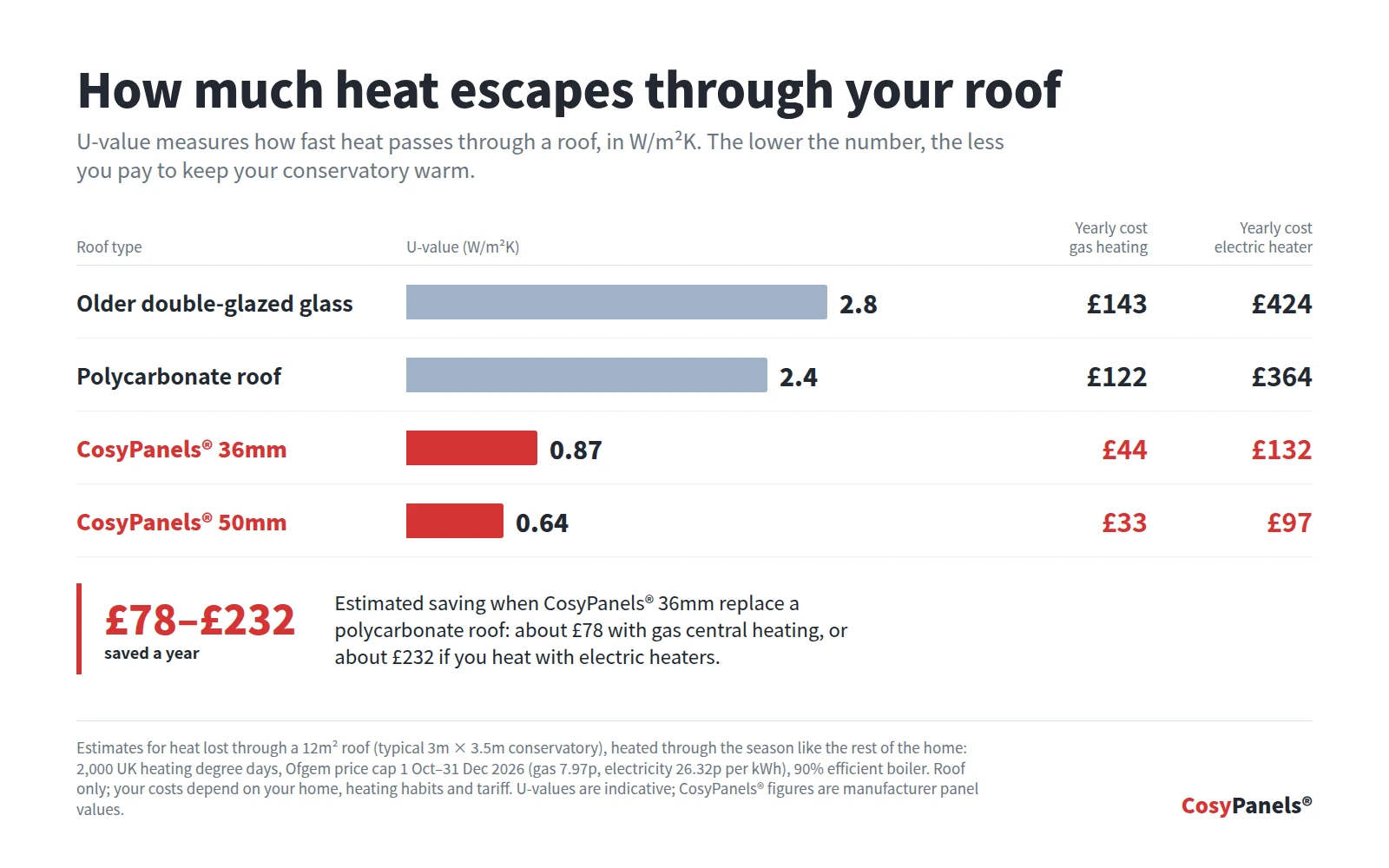
Single glazing, older double glazing and polycarbonate
Older single-glazed roofs, early double-glazed units and standard polycarbonate typically sit between 2.0 and 3.0 W/m²K. These are the least efficient roofs still found in many homes today, and they’re the main reason so many conservatories are too hot or too cold. See our guide to polycarbonate roofs and their alternatives.
Better-performing glass systems
Advanced glazing systems – premium double glazing or triple glazing – can achieve figures between 0.8 and 1.0 W/m²K, though this varies by product. Glass still lets solar heat through, so a glass roof can overheat on sunny days. We regularly replace blue and grey solar-control glass roofs where customers were still too hot in summer.
Insulated conservatory roof panels
Insulated roof panels such as CosyPanels® achieve around 0.87 W/m²K for the 36mm panel we usually install – about 64% less heat loss than polycarbonate – and because they’re opaque, they also block the solar heat that makes glazed roofs overheat. They replace the panes in your existing roof frame and are fitted from one day.
Tiled and solid roofs
A fully insulated tiled roof achieves the lowest U-values of all, around 0.15–0.18 W/m²K. The trade-offs are cost, weight, and a longer installation that usually needs building regulations approval. See our tiled roof guide.
Why the lowest U-value isn’t always the most comfortable
A conservatory will always be the brightest room in your home. That’s the point of it. Because so much of it is glass, it will never match an insulated extension on paper, and chasing the lowest possible roof U-value doesn’t change that.
What changes how the room feels is fixing the roof: no more cold ceiling above you in winter, and no more summer heat pouring in through the roof. Looking at the whole conservatory, a tiled roof cuts total heat loss by only around a further 18% compared with CosyPanels®, and both roofs block the summer sun.
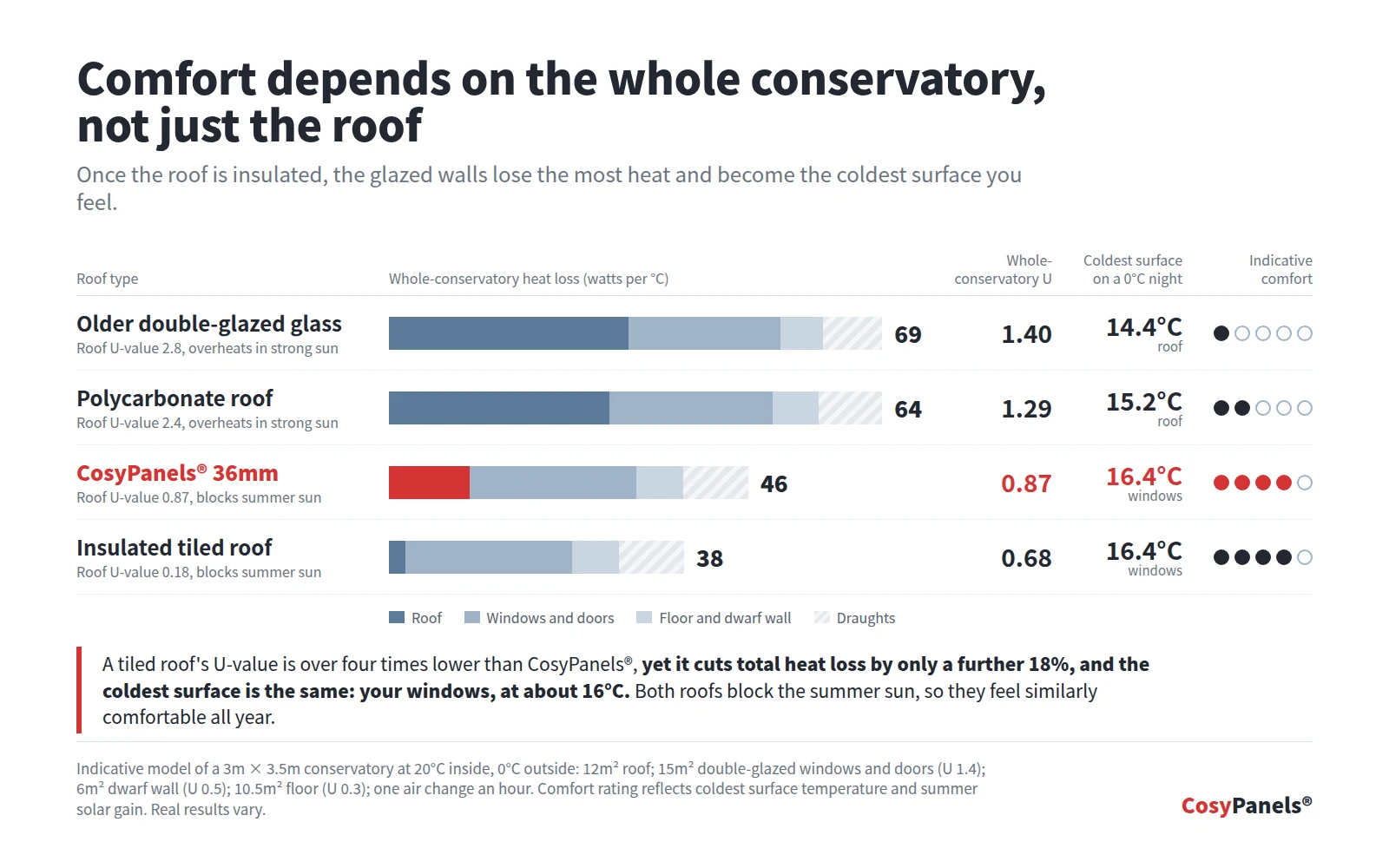
A tiled roof also costs considerably more. Here’s what the extra money actually buys in a typical conservatory:
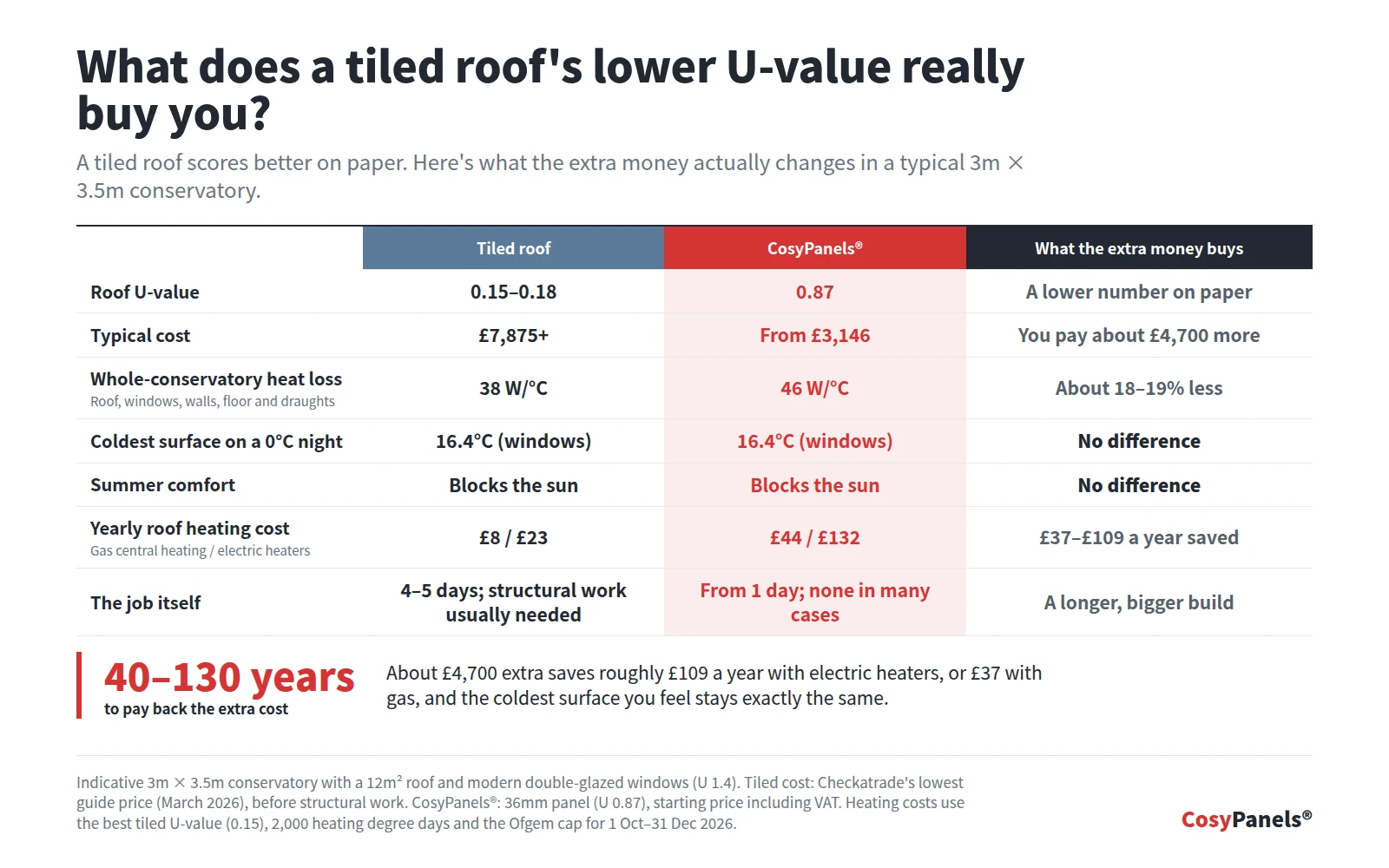
That’s why we design for comfort, not for the lowest number on a spec sheet: CosyPanels® make your conservatory as comfortable as possible, without you spending money on a U-value you’ll never benefit from.
When does a lower roof U-value matter?
In most conservatories, the walls are mostly glass. Once the roof is insulated, a tiled roof’s lower U-value makes little difference to how warm the room feels.
It’s different if your conservatory has solid, insulated walls. Then the roof is a bigger share of the heat loss, and a lower roof U-value counts for more.
Does a dwarf wall count?
No. The low brick wall under your windows makes little difference: almost all the heat still escapes through the glass above it. A lower roof U-value only starts to matter when at least two of your conservatory’s outside walls are solid and insulated from floor to ceiling, more like an extension than a conservatory. The walls need to be insulated too: an old single layer of brick loses heat almost as fast as glass.
If that describes your home, we’ll tell you honestly at your survey whether a tiled roof is worth it. For tiled roofs, we recommend our sister brand, All Seasons Roof.
What about G-values and solar gain?
U-value isn’t the only figure worth understanding. G-value measures how much solar energy passes through glazing – a factor that becomes particularly relevant in summer.
How G-values affect summer comfort
A high G-value means more solar heat enters the room, which can contribute to overheating on sunny days even if the U-value is relatively low. Balancing the two figures matters: a roof that insulates well in winter but allows excessive solar gain in summer can still leave your conservatory uncomfortable for part of the year. Opaque insulated panels and solid roofs block direct solar gain through the roof entirely.
Balancing insulation and daylight
The goal isn’t simply to block out as much light and heat as possible. With an insulated roof, the wall windows stay glazed, so the room keeps plenty of daylight while the roof controls heat loss and overheating. That’s why roof specification should consider U-value, G-value and daylight together, rather than looking at any one figure in isolation.
Choosing the right conservatory roof for energy efficiency
With so many figures to weigh up, it helps to know what actually matters most for your situation.
What to prioritise
- Low U-value for better heat retention in winter and reduced heat loss overall
- Control of solar gain to avoid overheating in summer
- Material durability so performance doesn’t degrade over time
- Compatibility with your existing conservatory frame to avoid unnecessary structural work
Questions to ask before upgrading
Before committing to a conservatory roof upgrade, it’s worth asking:
- What U-value does this roof achieve, and is that figure for the panel or the whole roof?
- How will it handle summer solar gain compared with my current roof?
- Will this option fit my existing frame, or does it require structural changes?
- What warranty is provided on materials and installation?
A reputable installer should be able to answer these clearly, without vague or unverifiable claims.
Frequently asked questions about U-values
What is a good U-value for a conservatory roof?
A good U-value for a conservatory roof is generally below 1.0 W/m²K. CosyPanels® insulated panels achieve around 0.87 W/m²K (36mm) to 0.64 W/m²K (50mm), and a fully insulated tiled roof can reach around 0.15–0.18 W/m²K. Anything above 2.0 W/m²K, such as older glazing or standard polycarbonate, offers comparatively poor thermal performance.
Are insulated roof panels more efficient than glass?
Insulated panels are far more efficient than standard double-glazed or polycarbonate roofs, with about 69% less heat loss than a standard glass roof and 64% less than polycarbonate. Premium triple glazing can reach similar U-values, but it costs more and still lets in solar heat, so a glass roof can overheat in summer in a way an opaque insulated roof doesn’t.
What is the U-value of CosyPanels®?
CosyPanels® have a U-value of around 0.87 W/m²K for the 36mm panels we usually install, and around 0.64 W/m²K for 50mm panels. These are panel figures from the manufacturer’s product data.
Is a tiled roof warmer than CosyPanels®?
On paper, yes: a fully insulated tiled roof has a lower U-value. In a typical conservatory with glazing above a dwarf wall, though, it cuts total heat loss by only around a further 18%, the coldest surface you feel stays the same, and it costs thousands more. It only starts to make a real difference when at least two outside walls are solid and insulated from floor to ceiling.
Can improving U-value help improve EPC performance?
Improving the U-value of a conservatory roof can support better overall thermal performance in the home, which may be reflected in EPC assessments depending on how the conservatory is used and connected to the main dwelling. It’s one of several factors that contribute to a property’s overall energy efficiency. See our guide to improving your EPC rating.
Making an informed decision
Understanding U-value turns an overwhelming technical spec sheet into a straightforward comparison tool. The lower the number, the better the material performs at keeping heat where you want it – but comfort depends on the whole conservatory, not just the roof.
When you’re comparing conservatory roof options, look beyond price alone. Check the U-value, ask how the roof handles solar gain, and consider how they work together for your specific conservatory. If you’re considering updating your conservatory, request a free survey and a clear, fixed quote from CosyPanels.